
Image
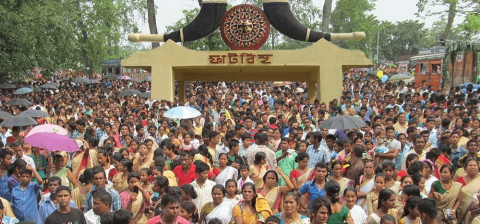
From 16th Century onwards, on the bank of the river Charikodiya, a gathering known as the “Phatobihu” is being celebrated annually, till date. For convenience it is now celebrated on the month of “Bohag” (of Assamese Calendar) and the dates are considered according to the last Friday, Saturday & Sunday of the month. This is now considered as the traditional auspicious occasion of Dhakuakhana, under Lakhimpur district, Assam. The immense beauty on the bank of the river where the occasion takes place could, none other than the “Mohghuli Chapori”, an area where nature has its own wonderful way to express its wonder with tall trees, green grass and soft cool breeze blowing away the dark shades of everybody‟s life. “Phatobihu” is a platform for all to be bound with the same threads of love, brotherhood and equality irrespective of caste, creed and religion since the Ahoms ruled the place. Thus, it possesses some specific characteristic and significance of its own although “Bihu” is celebrated all over as in Dhakuakhana in the same way.
There is no written history about “Phatobihu”, and so there is no definite evidence, that describes best, traditional festival. But people residing in this region have been holding this occasion as a means of cultural investigation programme.
According to Tai language “Phat” means - A place beside a river or some deep water bounded area where goods are exchanged for trade and tax collected.
According to Ahom Lexicans, “Phat” means – A place where traders assemble for trade and for the payment of duty.
Legendarily speaking, there are many takes related to “Phatobihu”. But one such tales that still counts is worth mentioning.
During the Ahom rule, a vast area was under the control of the Ahom rulers. Both the North & South bank of the river Brahmaputra was occupied by them. So, accordingly, the officials from the court representing the Ahom rulers gave a visit in this region annually. As an easy means of communication, they travelled along the water ways by the river Brahmaputra and the sub-rivers and reached this land.
To mark their visit, the people organized a grand welcome for the officials with great enthusiasm. The common people eagerly came out to pay their taxes to these officials‟ thereby organized cultural events for their entertainment.
It was a 7 days process and so the people from different castes and communities exhibited their own cultural songs and dance forms. The whole region was indeed transformed into a place for “merry-making and joy”. Happiness reigned over the region. Although the sole reason for this gathering was “to pay taxes” yet it was dominated by the festive mood of the commoners and thus “Phat” was transformed into “Phatobihu” in course of time.
Previously Phatobihu was confined with small tribal and non-tribal communities only. Later on it came out to be celebrated regionally. In 1918 Phatobihu had a halt in its celebration due to freedom movement. People, who previously dominated to sing and dance in the festival, disagreed to participate.
Later towards the end of the 20th century, Phatobihu again regained their rhythm with some happiness and merry making. In 1976, Phatobihu was officially organized in Dhakuakhana Govt. M.E. School field. From 1996, Phatobihu came to their own traditional field in “Mohghuli Chapori” on the bank of river Charikodiya to regain their long lost vigor and charm.
Legendary literaturist Homen Borgohain denoted the present Phatobihu celebrating region as the “Mohghuli Chapori” in his noted short story “Gorokhia” situated on the bank of the river Charikodiya towards the western part. The natural beauty of the river and the immense greenery all around its surroundings soothe away the heart and soul. Phatobihu becomes lively with nature – the tall green trees, orchids and cooing of the birds put upon an additional flavor for the festival to end with success. An additional drizzling of “rain” does not fade away the beauty and the people to gather enlighten “Mohghuli Chapori to its best.
Phatobihu holds its own special significance and characteristics. The organizers take immense effort to organize Phatobihu with the same traditional way, as it used to be, with the slightest modification. The ethnicity and the flavor of cultural programmes are organized in a systemic manner with the view that the customs and traditions are not hampered, dishonored or misguided.
The land known as the “land of golden thread”, people sought to wear dresses made of this golden thread or the Muga silk.
The people gathered in the Mohghuli Chapori prefer to wear their own traditional dresses like the mekhla -sador by the females of all community and dhoti punjabi by the males. Gamosa is carried by both males and females.
However, other communities prefer their own traditional clothes. This is to make traditional cultural customs, rites and rituals popular so that it does not get lost with the young generation. The people of the region as a whole takes immense care to preserve Phatobihu in its own way so that the rapid growth of globalization does not lays any impact upon it.
National Dramatist and literary person Dr. Chandradhar Chamuah reviews as – The residents of the bank of river Luit the Mising teenagers visited Phatobihu with their colourful traditional attires with great enthusiasm.
During daytime, they enjoyed themselves in the region of some land locks or in Mohghuli Chapori. But with the passage of time and due to the impact of the Bengali culture, the aristocratic category of people considered Bihu with great ignorance. Thus, the culture of “Rati Bihu” came into existence amongst the common people. In course of among all. However, the actual trends of bihu exhibiting tragedy, romance and love was kept alive by the Kaivartas can be said that Phatobihu was kept alive with true ethnicity and velour by these two main groups of people – the Kaivartas and the Misings – the ultimate common people related to land, water and air in the true sense.
According to legendary literary person Homen Borgohain opines – „Phatobihu is the very own folk culture of Dhakuakhana surrounded the Mising Community from all sides, the people come out in groups to dance and sing on the bank of the rivers Charikodiya to enjoy in the same platform. Their enjoyment is joined by other communities of the land the region reaches a festive season peak. People from all around the region visit this place to get a glimpse over the varieties of traditions of different people representing different community. The bihu continued for seven days and seven nights …”
Dr. Nagen Saikia, Vice-President of Asom Sahitya Sabha, educationalist literary person reviews- “Phatobihu is organized on the bank of the rivers, Charikodiya where the greenery and scenic beauty predominates. People from different cultures and community gather here each community exhibit their own dance form the whole day long. The common people gather to get a glimpse of these gathering, the cultural integration gathering. The whole region becomes extremely occupied by the spectators and there is not a small vacant space spared. However, there is not any indiscipline or any disorganized to be seen anywhere. The people around remain calm, disciplined and well organized to enjoy. This is the special feature of Phatobihu with traditional attire. The females wear mostly Paat (silk), Muga (silk) or Cotton dresses mostly colorful Mekhela Chadors that care appealing and the males from the smaller ones to the older ones wear dhoti-punjabi and gamosa. This is infect a Mela (gathering)-Bihu mela (Bihu gathering)”.
According to Dr. Nirmal Kumar Choudhury, Ex-Vice Chancellor of Gauhati University opines- “It‟s amazing and wonderful to find people organized in small groups under the trees dancing and singing in their own rhythm, exhibiting their own rich culture. Interestingly, the spectators enjoying this exhibition includes all age group person young to the aged ones. In ancient times, people used to enjoy music and dance in this way. That is why, this tradition is still present in Phatobihu which makes the event practically different, it seemed”.
Another spiritual personality Sattradhikar of Aauni-Ati Satra, Dr. Sri Sri Pitambar Dev Goswami opines – “The word “Phatobihu” itself brings joyous and festive merriness of the people. Bihu is a festival of unity and integrity though of the community. Bihu is a festival of mass integration. Phatobihu is a platform for the integration among different communities bonded with the means of brotherhood, love and unity. Thus, Phatobihu might have existed base upon this theory.
Since the Atom‟s r e i g n , the celebration of Phatobihu has depicted t h e rich cultural heritage of the people of Dhakuakhana. This festival is the pride of Assam as a whole. The festival is an example of unity and integrity of the people of Dhakuakhana irrespective of caste, creed, religion, race and community and perfect exhibition of our rich culture”.
According to Rang Bang Terrang, Ex-President of Asom Sahitya Sabha “From the days of Ahom rule, Phatobihu of Dhakuakhana has been depicting a picture of cultural richness of the people of Dhakuakhana. Phatobihu is not confined to the people of Dhakuakhana but has become the pride of Assam. The exhibition of the different kinds of tribes and communities like the Mising, Deori, Kaibarta, Ahom, Chutiya, Koch, Kalita, Bodo, Kachari, Nepali, Adivasi, etc. are infect bonded by the same bond of integrity and therefore sets an example of appreciable beauty of love and brotherhood among them”.
Reknowned writer, philosopher, and a person acting as a bond between the people of hills and plains. Yese Dorje Thengse reviews – “The spontaneous celebration of people from different communities displaying their own cultural traditions in a wonderful atmosphere of greenery is itself a very good symbol of the great Assamese Community at Phat rule. In ancient times, previously NEFA starting from the Swargadeo rule to the pre-independence period people from the communities like “Apatani, Aoka, Dofola, etc. tribal people participated in the trade and commerce of Dhakuakhana beside the river Charikodiya, and also participated in the merry-making festive season of Phatobihu where artificiality does not pre-dominates in the Phatobihu which is the special features of this festival”.
| Title | Size | Type |
|---|---|---|
| PHATOBIHU | 252.45 KB |
